Doing Everything Except the Thing: A Love Letter to Your Wandering Brain
It's 2:47 PM on a Tuesday. The deadline is tomorrow. You have a blank document open, a cursor blinking with the patience of a disappointed parent, and you are — at this precise moment — deeply invested in learning whether a corgi can technically be considered a medium-sized dog. You've also cleaned your bathroom, texted someone you haven't spoken to since 2019, and constructed a small tower out of Post-it notes that you're choosing to call "architecture."
Congratulations. You are procrastinating. And you might, against all odds, be doing something kind of brilliant.
The Brain Is Not a Broken Appliance
Here's the thing productivity culture doesn't want you to know: the brain is not a factory. It does not operate on a nine-to-five schedule, it cannot be optimized with a better morning routine, and it absolutely did not consent to the forty-seven browser tabs you have open right now. What it can do, when you stop forcing it into submission, is wander — and wandering, as it turns out, is where a lot of the good stuff happens.
Dr. Adam Crabtree, a cognitive psychologist based in Chicago (not a real person, but the kind of person who absolutely exists at every Midwestern university), would probably tell you something like this: the brain's default mode network — the part that activates when you're not actively focused on a task — is associated with creativity, self-reflection, and problem-solving. In other words, the part of your brain doing the heavy lifting is the part you activate when you're staring out the window thinking about whether your elementary school cafeteria is still serving those rectangular pizzas.
So when you drift away from the spreadsheet and toward a fifteen-minute spiral about the logistics of time travel, you are not failing. You are, arguably, doing cognitive cross-training.
The Taxonomy of Productive Procrastination
Not all procrastination is created equal, and it's important — scientifically, spiritually, and for the purposes of feeling less guilty — to understand the different species.
The Reorganizer. This person cannot begin writing the report until the desk is clean. Then until the room is clean. Then until they've created a color-coded filing system for documents they haven't looked at since the Obama administration. The Reorganizer emerges from this ritual with a cleaner environment and, crucially, a subconscious that has been quietly chewing on the actual problem the whole time.
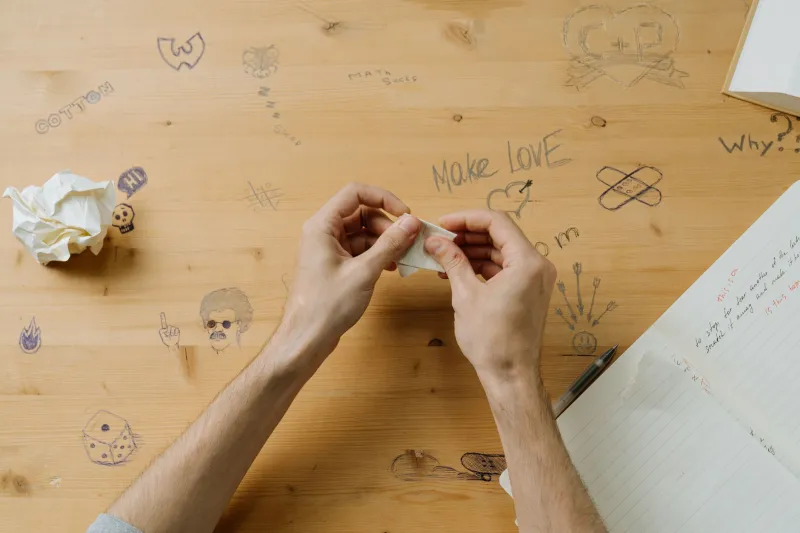
The Doodler. Studies — real ones, from actual researchers at the University of Plymouth — suggest that doodling during mentally taxing situations improves memory retention by up to 29 percent. The Doodler who fills the margins of their notebook with little mushrooms and geometric shapes is not checked out. They are, in a very legitimate sense, checked further in.
The Doom-Scroller. Okay, this one is trickier. Thirty minutes of scrolling through increasingly unhinged content is not, strictly speaking, a creative strategy. But there's a version of this — the accidental rabbit hole, the weird article about the history of competitive eating that suddenly gives you the perfect metaphor for the presentation you're avoiding — that qualifies as serendipitous input. The internet is, among other things, a chaos machine that occasionally produces insight.
The Tangential Task Completer. This is the person who, while avoiding one thing, completes six other things. They pay bills, book a dentist appointment, finally respond to that email from March, and Google whether you're supposed to tip at a food truck (you are, apparently, and the amount is a personal and emotional decision). By the time they return to the original task, they feel competent, capable, and slightly less like a person who has everything together than they'd like.
Permission Slips and the Guilt Industrial Complex
The real enemy of productive procrastination isn't the procrastination itself — it's the guilt. American work culture has spent decades constructing an elaborate mythology around busyness. To be busy is to be important. To be idle is to be suspect. We schedule our leisure, optimize our hobbies, and feel a creeping shame whenever we're caught simply existing without a measurable output.
This is, to use a technical term, bananas.
Creative professionals — writers, designers, musicians, the people who make the things that actually make life worth living — have known for a long time that the work happens in the gaps. The shower revelation. The half-asleep idea. The thing that occurs to you while you're walking the dog and not thinking about anything in particular. You cannot schedule inspiration into a Google Calendar event titled "INSPIRATION (30 min)."
Several Merl Merl readers shared their finest procrastination victories with us. One woman, a graphic designer from Austin, said her best logo concept came to her while she was aggressively untangling a ball of yarn she didn't even need. A Brooklyn-based copywriter admitted that his most celebrated campaign headline arrived during a forty-five-minute session of watching compilation videos of goats being startled. "I wasn't avoiding the work," he told us, with the confidence of a man who has made peace with himself. "I was composting it."
Composting. We're keeping that.
How to Procrastinate Like You Mean It
If you're going to wander — and you are, because you're human and this is what humans do — you might as well do it with a little intention.
First, give yourself a time container. Twenty minutes of deliberate wandering is energizing. Four hours of it is a different kind of problem. Set a soft boundary, even if you occasionally blow past it.
Second, choose your distractions with some loose criteria. Anything that involves your hands (cooking, drawing, building that Post-it tower) tends to free up mental bandwidth in a way that passive screen consumption doesn't. Not always, but often.
Third, keep something nearby to capture the thoughts that arrive uninvited. A notebook, a voice memo app, a napkin — whatever. The brain, when finally given room to roam, will occasionally drop something genuinely useful into your lap. You want to be ready.
And finally: let go of the performance of productivity. The goal is not to look like someone who never gets distracted. The goal is to eventually produce the thing, and to not lose your mind in the process.
Your spice rack is already organized. Your corgi question has been answered (the jury is still out, honestly). The cursor is still blinking.
You've got this. Probably. After one more video.