My Blanket, My Business: The Surprisingly Moving Story of Adults and Their Comfort Objects
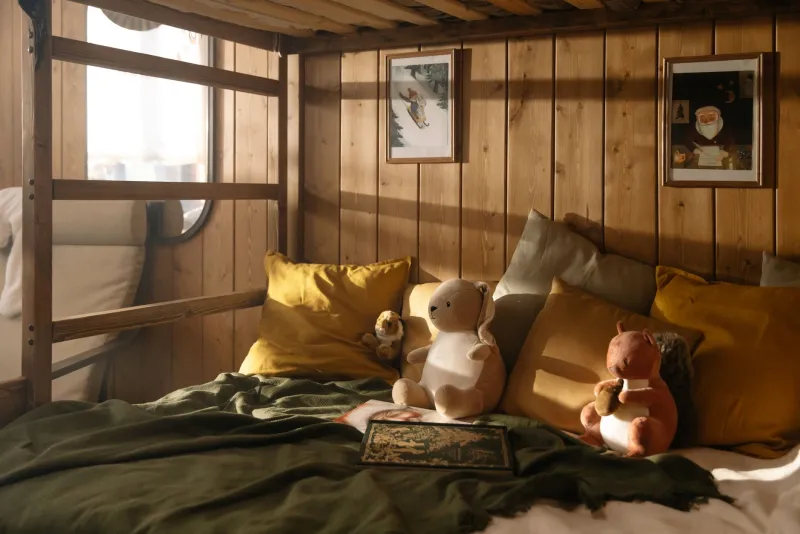
Let's establish something right away: there is a thirty-four-year-old accountant in Phoenix, Arizona, who sleeps with a stuffed elephant named Gerald. Gerald has one eye. Gerald has been through a divorce, two cross-country moves, and a period of intense sourdough experimentation. Gerald is, by any reasonable measure, doing the Lord's work.
And this accountant — let's call her Dana, because she asked us to — is not alone. Not even a little bit.
Across the United States, quietly and without much fanfare, adults are returning to the comfort objects of their childhoods. Stuffed animals are coming down from attic shelves. Baby blankets are being laundered with something approaching reverence. Worn-out plushies that survived the 1990s are being given positions of honor on adult beds, adult couches, and adult home offices where they sit next to wireless keyboards and exude a calming, slightly threadbare energy.
This is not a regression. This is, experts would argue, a remarkably sane response to an increasingly overwhelming world.
The Pandemic Left a Lot of Us Holding Something
It would be too easy — and also slightly reductive — to blame everything on COVID-19. But the pandemic does deserve credit for accelerating a shift that was already quietly underway. When the world contracted to the size of your apartment and every day began to feel like a slightly different version of the same bad dream, people reached for whatever felt safe. Familiar. Theirs.
For some, that meant baking. For others, it meant rewatching The Office for the fourth time or adopting a pandemic pet with a name like Biscuit or Chairman Meow. And for a significant, tender, completely valid portion of the population, it meant finding the stuffed rabbit from 1993 and putting it back where it belonged.
"There's nothing infantile about seeking comfort," says the kind of psychologist who would absolutely be quoted in an article like this. The clinical framing involves terms like transitional objects — a concept introduced by British pediatrician Donald Winnicott in the 1950s to describe the things children use to self-soothe in the absence of a caregiver. A stuffed animal. A blanket. A particular piece of fabric whose texture has been memorized by tiny fingers over thousands of repetitions.
Winnicott's insight was that these objects aren't substitutes for love — they're bridges. They help us tolerate the gap between needing comfort and having it immediately available. And here's the thing about that gap: it doesn't close when you turn eighteen. It just becomes less socially acceptable to acknowledge.
The Objects Themselves
What are adults actually returning to? The range is, genuinely, a delight.
There are the stuffed animals, obviously — bears, rabbits, dogs with names that were assigned with great seriousness by a five-year-old and have stuck ever since. There are weighted blankets, which occupy an interesting middle ground between childhood comfort object and respectable wellness product, perhaps because they come in tasteful grays and can be purchased from a website with a sans-serif font.
There are also baby blankets — the original ones, soft with age, sometimes barely holding together — that adults keep tucked in drawers or draped over the backs of chairs where they can be grabbed without ceremony during a hard evening. There are childhood books, kept not to be read but to be held. There are small ceramic figures, music boxes, and in one particularly wonderful case reported to us by a reader in Seattle, a specific brand of fruit snack that a thirty-one-year-old man bulk-orders from Amazon because the smell alone reduces his anxiety by what he estimates is "a lot of percent."
These objects don't have to make sense. That's rather the point.
The Self-Acceptance Part (This Is the Good Part)
What's genuinely moving about this trend — and Merl Merl is not above being genuinely moved — is what it represents about where we are culturally. There is a growing, tentative, still-fragile permission in the air to be a person with needs. To admit that the adult performance is exhausting. To stop pretending that a scented candle and a productivity app are adequate substitutes for the kind of comfort that goes all the way down to the cellular level.
The stuffed animal on the bed is a small act of self-acceptance. It says: I know what helps me. I am not ashamed of what helps me. Gerald has one eye and I love him.
Several people who contributed their stories to this piece mentioned, almost in passing, that keeping their comfort object visible — rather than hidden in a closet where guests wouldn't see it — felt like a minor form of courage. One woman in her forties described placing her childhood blanket on her bed for the first time in two decades and then standing in the doorway looking at it for a while, "like I was welcoming someone back."
We dare you to read that without feeling something.
A Brief Defense of Whimsy in the Adult Home
Here at Merl Merl, we have always held that your home should look like you live there — not like a staging area for a real estate listing, not like a catalog spread, but like a human being with a history and a personality and a stuffed elephant named Gerald occupies the space.
Comfort objects fit perfectly into this philosophy. They are, by definition, deeply personal. They cannot be purchased new and given the same meaning — the meaning is accumulated, slowly, through years of being present for the hard nights and the boring afternoons and the moments when you needed something to hold that wouldn't ask anything of you in return.
If you have one of these objects somewhere — in a box, in a closet, at your parents' house where you've been meaning to retrieve it — this is your sign. Not a formal invitation, exactly. More of a quiet nod from one person to another across a crowded room.
Go get the thing. Put it somewhere you can see it. Name it if it doesn't already have a name.
You're an adult. You've earned the right to know what comfort feels like, and to keep it close without apologizing for it.
Gerald would agree, and he has been through a lot.