The Broken Blender Theory: What the Junk in Your Closet Is Actually Trying to Tell You
Let's do a quick inventory.
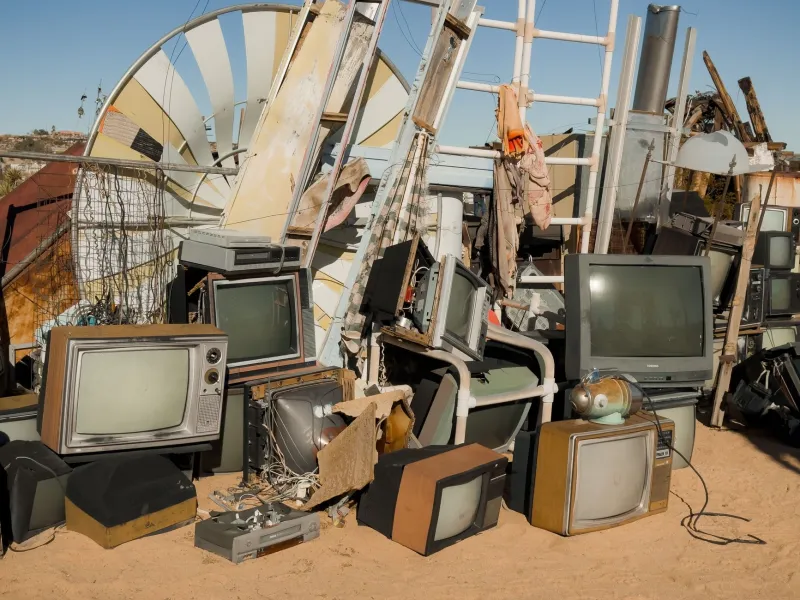
Somewhere in your home — in a closet, a junk drawer, a garage shelf, or that one cabinet everyone pretends doesn't exist — there is almost certainly a broken thing. Maybe it's a rice cooker that stopped working in 2019 and has been sitting on the counter like a small monument to optimism. Maybe it's a first-generation Kindle, a tangled mass of charging cables for devices you no longer own, or a waffle iron that makes exactly one functional waffle before giving up entirely.
You have not used it. You have not fixed it. You have not thrown it away. And if someone suggested that you should throw it away, you would feel, for just a moment, an inexplicable flash of resistance.
Why? That is the genuinely fascinating question. And the answer, it turns out, has almost nothing to do with waffle irons.
Objects Are Not Just Objects
Psychologists have a term for the emotional weight we assign to physical things: object attachment. It sounds clinical, but the concept is deeply human. We don't just own things — we form relationships with them. We associate them with moments, with versions of ourselves, with people we used to be close to or aspirations we used to hold.
The broken blender isn't just a broken blender. It might be the one you bought when you moved into your first apartment, when you were going to make smoothies every morning and be a person who had their life together. The lamp that doesn't work might have been your grandmother's. The dusty guitar in the corner isn't just a guitar — it's the version of you who was definitely going to learn to play.
Throwing any of those things away doesn't just mean throwing away an object. It means closing a door. Admitting something. And the human brain, which is extremely talented at avoiding uncomfortable admissions, would rather keep the broken blender forever than deal with whatever feelings live underneath it.
The "What If" Machine
There's a second force at work here, and it operates on pure hypothetical logic. Professional organizers call it "what if" thinking, and it is the sworn enemy of every clean closet in America.
What if I need it someday? What if I fix it? What if I find the other piece? What if a situation arises that requires exactly this broken, outdated, non-functional item?
The rational part of your brain knows that the situation requiring your 2009 flip phone is not coming. It knows that the bread maker you've never used is not going to start getting used. It knows that "someday" is not a date on the calendar.
But the what-if machine doesn't run on rationality. It runs on anxiety and the deeply uncomfortable feeling that getting rid of something is a permanent, irreversible act. In a world full of permanent, irreversible things, holding onto a broken blender feels like keeping your options open. It's a small, low-stakes form of control.
Professional organizer Dana Holloway, who has spent years helping people excavate their homes, describes it this way: the junk isn't the problem. The junk is the symptom. "When someone can't let go of something broken," she says, "I always ask: what does keeping it let you believe? That's where the real conversation starts."
The Guilt Object
There is a specific subcategory of broken things that deserves its own mention: the guilt object. This is the item you keep not because you love it or might use it, but because throwing it away would feel like a personal moral failure.
The exercise equipment is the classic American example. The stationary bike, the resistance bands still in their packaging, the yoga mat rolled up in a corner with the energy of a promise you made to yourself and then quietly didn't keep. These items are not just objects. They are physical evidence. Throwing them away means admitting that the version of you who was going to use them is not coming. Keeping them means the jury is still out.
The same logic applies to the language learning app subscription you paid for, the cookbooks you've never opened, the art supplies from the phase you were going to have. These things are not clutter. They are the physical form of your own aspirations, and they carry a weight that has nothing to do with their actual mass.
What the Organizers Actually Say
The professional organizing world has wrestled with this tension for years, and the consensus is more nuanced than the "if you haven't used it in a year, toss it" rule that gets passed around like gospel.
Therapist and clutter consultant Renata Voss makes a distinction between sentimental keeping and self-sabotaging keeping. Sentimental keeping — holding onto your grandmother's lamp because it makes you feel connected to her — is healthy and valid. Self-sabotaging keeping — holding onto the lamp because dealing with it means dealing with grief — is a different thing.
"The question isn't whether an object has meaning," Voss explains. "Everything has meaning if you look hard enough. The question is whether keeping it is serving you, or whether it's keeping you stuck."
The broken blender can go. The feeling underneath the broken blender might need a little more attention.
A Gentle Defense of the Junk Drawer
Here, though, is where Merl Merl would like to offer a small, affectionate counterpoint: not all broken-thing-hoarding is pathology. Some of it is just deeply, wonderfully human.
There is something kind about the person who keeps their grandmother's non-functional lamp because they're not ready. There is something optimistic about the person who still believes, against all evidence, that they will one day fix the rice cooker. There is something almost poetic about the 2009 flip phone sitting in a drawer like a tiny time capsule of a different era.
Your home is not just a storage unit. It's a record of who you've been and who you thought you'd become. Some of that record is broken. That's fine. That's honest.
Just maybe don't buy another waffle iron until you figure out what happened to the first one.
And by "figure out," we mean emotionally process, not literally repair. We're not miracle workers.